- GDPRiS, part of the ParentPay Group, releases research showing governance challenges in the use of AI in MATs
- Free AI Governance & Readiness Assessment launched by the company to support MATs and schools understand and improve their AI governance
GDPRiS, the data protection and GDPR compliance platform for schools and multi-academy trusts and part of the ParentPay Group, has released research showing a significant gap between the number of trusts who have an AI policy in place and those who are converting activity into meaningful leadership assurance.
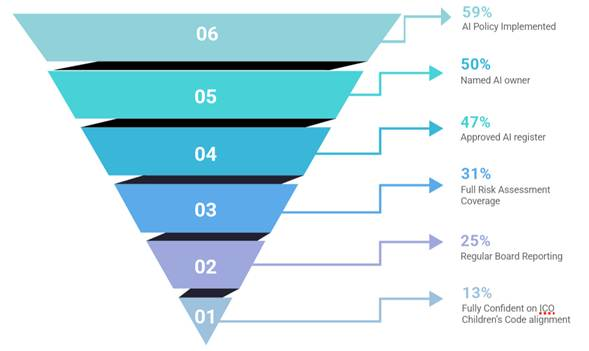
Coined ‘The Assurance Gap’, the research shows that while 59% of respondents have an AI policy in place, only 50% have a named owner for AI, just 31% have completed risk assessments for all approved tools, only 25% report regularly to their board or trust leadership, and only 13% said their trust was confident that AI use by children aligns with the ICO Children’s Code. The findings reveal a clear maturity pattern across the sector: formal AI policies are increasingly common, but maturity progressively decreases as governance moves from policy to ownership, operational control, assurance and compliance confidence.
Elliott Lewis, Chief Information Security Officer, ParentPay Group, said: “AI creates so many opportunities in education, particularly in gathering data insights at speed and at scale, and making administrative processes more efficient. When academies and schools adopt AI with all the governance processes in place, it can be transformative. But AI is moving incredibly quickly and academies are telling us that it’s moving faster than they can govern and often beyond their levels of expertise.”
In response to The Assurance Gap research findings, and to support Academies and schools adopt AI with appropriate governance measures in place, GDPRiS has launched a free AI Governance & Readiness Assessment. The assessment, which takes 10 minutes to complete gives Academies and schools a personalised AI Governance Readiness Score, identifies strengths, risks and gaps, measures governance maturity, understands AI adoption and impact, whilst also providing them with tailored recommendations and free resources to support their AI governance journey.
Elliott Lewis added: “Academies and schools need to focus on their primary purpose – achieving great learning outcomes for pupils. That’s why we’ve launched this Readiness Assessment. In just 10 minutes they can understand where they are on their governance journey and get personalised recommendations on how to move forward, supporting their use of AI in a safe and secure way.”
The same study found that AI adoption has moved firmly beyond experimentation and is becoming an established part of operational and educational practice in trust schools. Almost two-thirds of respondents in the research, 69%, described their AI usage as ‘moderate’, compared with 25% who reported limited use, 3% experimental use and 3% extensive use. Despite that, visibility of AI usage emerged as a significant governance challenge in the study, with policy guidance, self-reporting and technical controls providing oversight rather than a complete picture of AI usage. Respondents scored their confidence in understanding which tools are being used at an average of 5.8 out of 10.
Anecdotal evidence from the research points out the significant challenges trusts identify with improving governance across AI usage. In response to a question asking respondents what their biggest concern about AI in education was, some said “it’s moving quicker than we can keep up”, “in a trust our size, it’s what we don’t know [that matters]” and “the pace of change may result in constant changes to tools used, creating confusion for users”.
Matthew Sutton, Network Leader at Aston Community Education Trust, said: “Good AI governance in education shouldn’t start with the tools. It should start with the questions. We believe every Trust needs a clear line of accountability for AI: who assesses the risk, who signs off a new tool, who’s responsible when something goes wrong. And whatever the technology, a human being should always have the final say.
“At ACET, we’ve put that into practice through a Trust-wide AI Steering Group, chaired at Network Leader level and reporting to our Finance, Risk, Audit & People Committee. With so many AI tools available, we focus our scrutiny where it matters most: any tool that touches on data protection principles or processes personal data goes through a formal Data Protection Impact Assessment before it’s added to our Approved List, with a pilot phase and staff feedback built in before wider rollout. And because the tools themselves will keep changing faster than any policy can track, we’ve deliberately anchored our staff guidance in data protection principles rather than in any particular platform.
“The new assessment from GDPRiS will be incredibly helpful to trusts and schools who are increasingly adopting AI and are at the start of their governance journey. AI can be such a helpful tool but good governance is a non-negotiable and tools that help schools get it right are invaluable.”