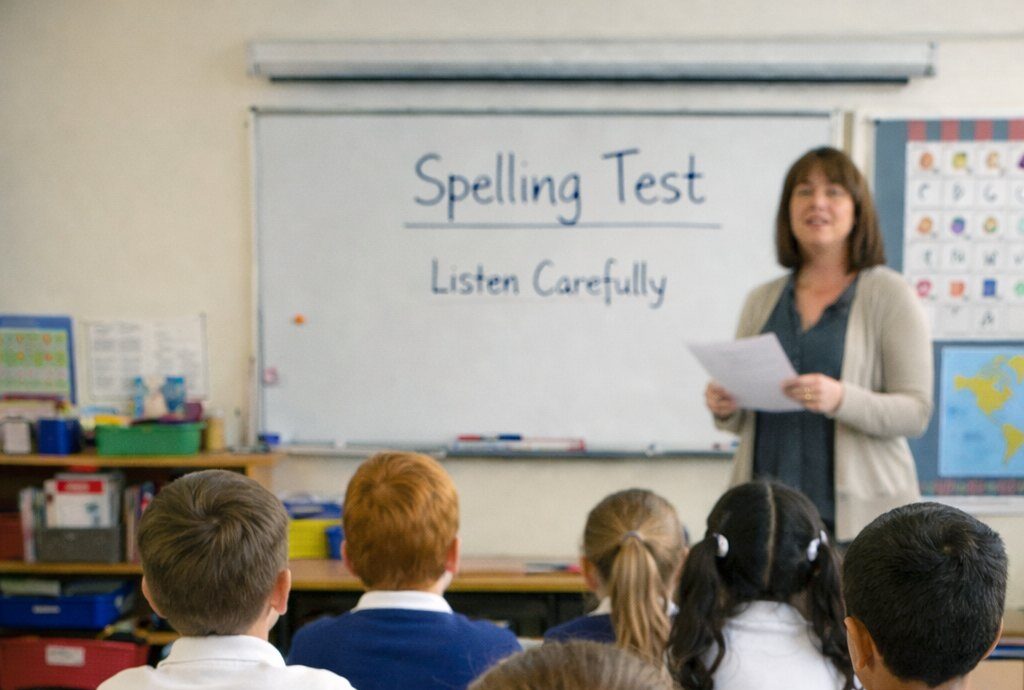
Analysis of more than 530 million spelling attempts by nearly one million children shows predictable patterns behind common spelling errors
As teachers and pupils write the word ‘February’ countless times this month, new research shows it remains one of the most frequently misspelled words in UK classrooms.
The findings, published by education platform EdShed, are based on analysis of more than 530 million spelling attempts made by 936,926 pupils. This makes it one of the largest studies of spelling behaviour ever conducted in UK education.

10 Most Misspelled Words
sketch
mischievous
February
couldn’t
mustn’t
license
definitely
indefinite
convenience
preferred
Alongside ‘February’, words such as ‘definitely’ and ‘mischievous’ consistently rank among the most frequently misspelled. The analysis shows these errors are not random. Instead, they follow clear, predictable patterns shared by pupils across the country.
Despite drawing data from schools across different regions and nations, the research found remarkable consistency in both the words most often misspelled and the types of errors made. This suggests spelling difficulty is a national challenge, shaped less by accent or dialect and more by how spelling develops over time.
Many errors were linked to phonological challenges, where pupils spell words as they sound, particularly when letters are silent or weakly pronounced. Words such as ‘February’ and ‘mischievous’ were often misspelled with letters omitted or rearranged. Other errors reflected morphological uncertainty, particularly when adding suffixes or doubling consonants, with words such as ‘preferred’, ‘committed’ and ‘regretting’ frequently causing difficulty.
Meaning-based confusion also featured prominently. Homophones such as ‘brake’ and ‘break’, ‘reign’ and ‘rain’ and ‘stationery’ and ‘stationary’ were commonly confused. Vowel-heavy words, including ‘definitely’, ‘convenience’ and ‘indefinite’, also proved especially challenging.
According to the EdShed team, spelling uncertainty can quietly affect writing confidence. When pupils hesitate over familiar words, it can interrupt the flow of their ideas and reduce writing fluency. Helping pupils understand spelling patterns reduces this cognitive load, allowing them to write more confidently and effectively.

Leanne Aston, a primary school teacher in Kettering, Northamptonshire, said: “This research reflects exactly what we see in the classroom every day. Children aren’t making random mistakes, they’re trying to apply rules and patterns they’ve learned, but sometimes they overgeneralise or miss the exceptions.
“The key is helping pupils understand the structure behind words – roots, prefixes, suffixes and spelling patterns – rather than just testing them on weekly lists. Regular reading makes a huge difference because children begin to internalise what ‘looks right’. Digital tools and spelling apps can also be incredibly helpful when they provide immediate feedback and make practice engaging. When spelling becomes less of a barrier, you can actually see children’s confidence in their writing grow.”
Rob Smith, chair of education at EdShed, said: “Looking at spelling at this scale shows that children’s mistakes are rarely careless. In most cases, they are applying logic. They are spelling words as they sound or making sensible guesses based on patterns, but they do not yet have the full picture.
“When we understand whether an error is phonological or morphological, we can respond much more effectively as teachers. Spelling improves most when pupils understand why words are spelled the way they are, rather than simply memorising lists.”
Similar spelling patterns also appear in EdShed data from South Africa, the United States and Australia. This suggests many spelling challenges, including silent letters, complex vowel patterns and homophones, are shared wherever English is learned.
EdShed says analysing spelling behaviour at scale allows teachers and schools to identify common barriers more precisely, enabling targeted support that helps pupils build confidence and long-term spelling accuracy.