Simpler Recycling 2025: How Are Businesses Preparing?

New research from Glasdon reveals how businesses are gearing up for the upcoming changes.
As the 31st of March deadline fast approaches, businesses across England are priming themselves for a major shake-up in how recycling and waste management is handled. With such major changes drawing closer, how exactly are businesses adapting to these new hurdles?
A new survey, commissioned by Glasdon UK Limited, asked 300 decision makers in the private sector to disclose how their businesses were preparing for the new regulations, and what measures they were taking to remain compliant. 
The majority of respondents (over 91%) said they were familiar with the new legislation, and 42% said they were also fully prepared for what it entails, indicating a high level of awareness amongst key decision makers.
Additionally, many respondents reported that their business is working on implementing the changes – 47% said that they were already somewhat prepared for Simpler Recycling, compared to just 10% that said they were ‘not very prepared’ or ‘not at all prepared’.
With only a couple of weeks left until the deadline, it appears most businesses are well on their way to achieving compliance. However, those that are just starting the process may struggle to achieve compliance without professional assistance.
When asked what steps their businesses had left to take, a total of 173 decision makers (or 58%) responded. The most common responses included ‘setting a timeframe for implementation’ (51%) and ‘reviewing our current recycling scheme’ (49%). 42% had yet to complete a waste audit and 43% hadn’t assigned a budget for the changes.


Interestingly, when asked about their timelines for implementation, 28% of the 300 decision makers planned to be fully compliant by the 31st of March deadline, with over 70% anticipating they will achieve compliance afterwards.
The broad majority of respondents set a completion date for a few months later, whereas 1.7% didn’t anticipate reaching compliance until April 2026, a full year after the deadline.
Given the fact that many decision makers are already in the implementation process (such as setting a timeframe and reviewing their current recycling schemes), it seems that most businesses are not only aware of the changes, but also adapting and embracing the regulations. 
While there may be a period of transition as many of these processes are finalised, it seems unlikely that the delays will last for long. 90% of respondents are fully prepared or in the process of preparing for Simpler Recycling, and very few businesses (1.3%) had taken no steps at all. If these trends follow, it seems highly likely that the vast majority of businesses will achieve compliance by this time next year. 
The survey from Glasdon was conducted from 14th February – 24th February 2025, from a pool of 300 decision makers in a range of midsize and large-scale private sector businesses. The survey covered businesses in all regions of England and from a variety of industry sectors.

What Is Simpler Recycling?

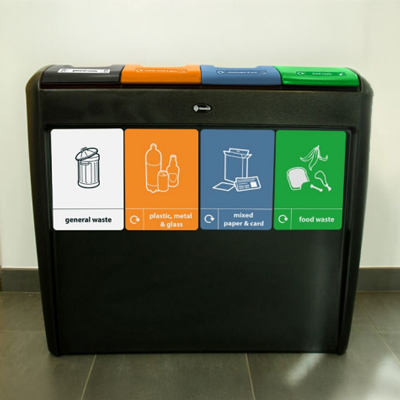
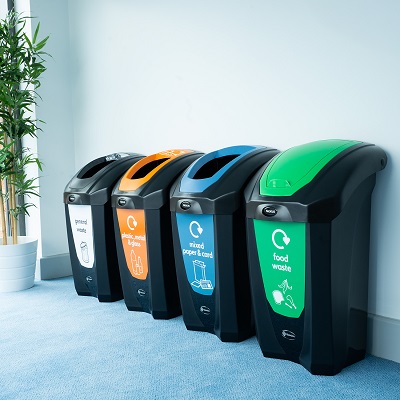
Simpler Recycling requires businesses and non-domestic properties to arrange for collection of core recyclable waste streams – glass, metal, plastic, paper and card, & food waste. Some types of waste – glass, metal, plastic – can be collected together in one ‘dry mixed recyclables’ waste stream.
 
Learn More:
 
eBook: Simpler Recycling For England


Methodology

The research was conducted by Opinion Matters on behalf of Glasdon UK Limited, among a sample of 300 x decision makers within businesses in the private sector (guaranteeing 100 in businesses employing 100-249 people, 100 in businesses employing 250-499 people and 100 in businesses employing 500+ people) with responsibility/influence into food waste and recycling collections for their England-based business.

The data was collected between 14.02.2025 – 24.02.2025. Opinion Matters abides by and employs members of the Market Research Society and follows the MRS code of conduct and ESOMAR principles. Opinion Matters is also a member of the British Polling Council.


css.php