Alex Dave, Safeguarding Education Officer at ed-tech charity, LGfL-the National Grid for Learning, shares advice on supporting parents to be part of the decision-making process in safeguarding their children.
It’s important to understand that if we have concerns about the parenting of a child, we cannot make that parent change. As Designated Safeguarding Leads (DSLs) it’s usual to have an altruistic drive to resolve situations – sometimes by telling people what to do, or else by doing it for them. However, this approach is rarely successful, and can de-skill people, creating dependency. Instead, we should try to achieve a balance between support and challenge to help parents better understand the situation, and enable them to make decisions about how they can protect their child.
By providing parents with practical and emotional support – within our professional boundaries – and challenging them to explore their understanding and behaviour through open-ended questions, parents can find solutions that work best for them and their family.
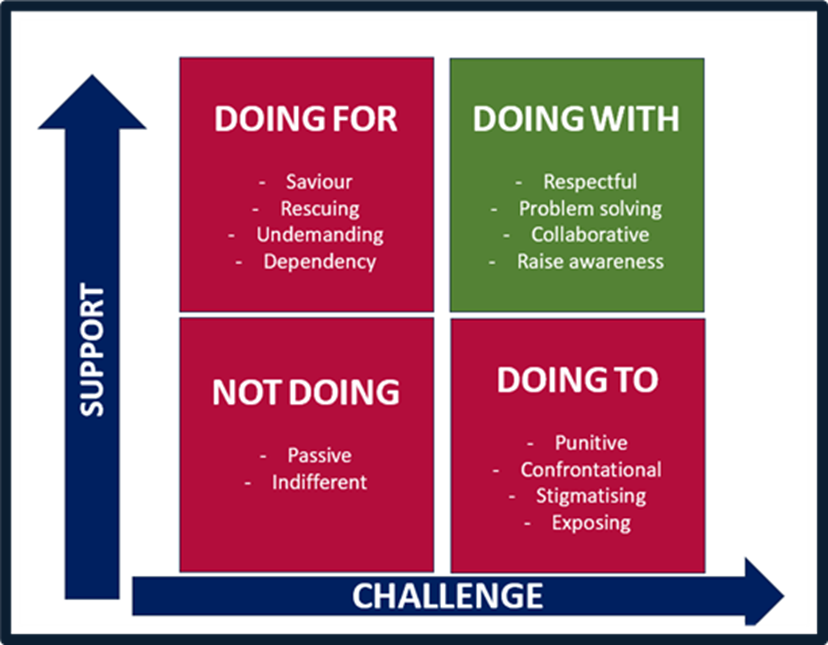
Laurent Daloz’s model of mentoring relationships (1986) illustrates this balance between challenge and support. Challenge without support is overwhelming and creates anxiety, while support without challenge leads to complacency and dependency – true learning and transformation occurs when there is balance.
Laurent Daloz (1986)
Daloz observed that:
- Low support and low challenge – Not doing – leads to little motivation for individuals to change
- High challenge and low support – Doing to – without sufficient support individuals feel overwhelmed and withdraw
- High support and low challenge – Doing for – the support is affirming for individuals but without challenge this leads to dependency
- High support and high challenge – Doing with – individuals are encouraged and supported to problem solve and find solutions themselves
By acknowledging the autonomy and power that parents have, we can help to empower them, and help build their capacity, self-awareness and motivation. It’s also crucial that when we are discussing safeguarding concerns with parents, we help them understand why we are concerned, and the impact – or potential impact this could have on their child. Often this is not as obvious to parents as you may think.
A parent’s knowledge may be limited for a variety of reasons, so rather than making assumptions about what they already know, it’s best to utilise our professional curiosity skills to explore and further this.
Our role is as an enabler – if the parents aren’t engaged, change is unlikely. Using the fundamental skills of relational practice – empathy, authenticity, unconditional positive regard and curiosity – we acknowledge that the solutions parents decide upon themselves, will nearly always be more effective and sustainable than any handed to them by professionals. Therefore, when we engage with parents about safeguarding concerns, it is critical that we support them to feel in control of any agreed actions, so that they have ownership.
Key questions to consider about a successful approach are:
- How is the involvement of parents in discussions about safeguarding concerns perceived? Is their role participatory and collaborative?
- How do we action plan withparents as a result of a safeguarding concern – are the plans empowering, supportive and challenging?
- Is a summary of the decisions provided for the parents to help support them and ensure they are aware of what actions have been agreed, and what they are responsible for?
- How do we follow up and support parents on the agreed actions, reflect on their progress and celebrate successes?
- How do we signpost support services, so parents can self-refer and access these independently as required?
These are some ways in which we can help parents to engage more effectively with safeguarding decision making processes at school, but the impact of adopting a relational approach can create much wider positive ripples across school life and the whole community.
For free information and resources on relational practice with parents, please visit https://lgfl.net/Safeguarding/Relational-Practice.