TWO CENTURIES HERE, is a new multi-space exhibition in the heart of central London, celebrating 200 years of ground-breaking scientific research, historical discoveries, artistic innovation and educational impact at the capital’s first university – University College London (UCL).
Through photography, objects, paintings, artefacts, and storytelling, the exhibition invites visitors to explore and discuss UCL’s rich history, influence and role in society, and collectively imagine what the future could look like.
This includes curious and fascinating objects from two of London’s most important museums, The Petrie Museum of Egyptian and Sudanese Archaeology and UCL Grant Museum of Zoology, alongside artworks from the UCL Art Museum and rare items from UCL’s historic and scientific collections, not usually open to the public.
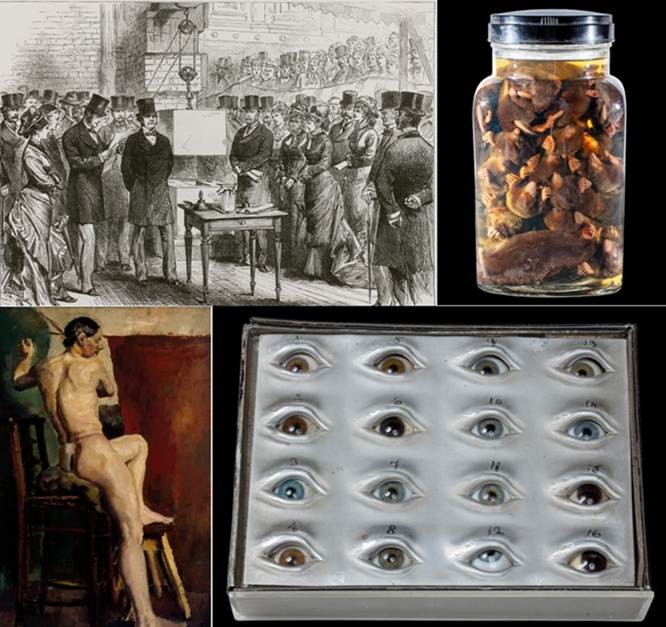
The exhibition features an eclectic range of objects, illustrating two centuries of curiosity, creativity and discovery. See The Grant Museum’s iconic Jar of Moles, the Crookes tube that led to the UK’s first clinical X-ray, a rocket nose cone linked to UCL’s Mullard Space Science Laboratory, the original test tubes used by Britains’ first Nobel Prize winner William Ramsay in his discovery of the noble gases, paintings and sketches from some of London’s first contemporary female artists including Winifred Knights and Amy Nimir, and the Shabti of King Taharqa, one of hundreds of important Egyptian and Sudanese funerary figurines at the Petrie Museum, one of the most important collections of Ancient Egyptian artefacts in the UK.
The exhibition also includes more challenging objects such as the Rudolf Martin Eye Colour Scale, that was used to categorise the eye-colour and assumed racial origins of Jewish migrant children in 1920s London, which now helps students to confront the legacy of eugenics. Other objects demonstrate the birth of electronics, advances in medical surgery and revelations from Nobel Prize winning thinkers of which UCL has 33.
As part of the TWO CENTURIES HERE Exhibition, visitors are also invited to explore both The Grant Museum of Zoology founded in 1826 as the first university museum in London and The Petrie Museum of Egyptian and Sudanese Archaeology founded in 1892.
The museums will be also hosting special public events and workshops to inspire fresh perspectives and meaningful dialogue around UCL’s historic collections, including Drawing After Hours – a series of free drawing workshops.
Exhibition Curators
Dr. Anna Garnett FSA has been the Curator of the Petrie Museum of Egyptian and Sudanese Archaeology, University College London, since 2017. She has worked at several local, national and university museums in the UK over the past two decades in a range of collections- and public-facing roles. She earned her PhD from the University of Liverpool in 2018 and has worked as a ceramicist and finds specialist in Egypt and Sudan for over 15 years. Anna has lectured on Egyptological and Museological subjects for over 20 years and has published widely for both general and academic audiences. She became a Fellow of the Society of Antiquaries in 2022.
Tannis Davidson Head of Zoology and Science Collections is responsible for the strategic and operational use of the zoology and science collections in teaching, research, exhibitions and public programming. Tannis leads the curatorial teams at the Grant Museum of Zoology, UCL Pathology Museum and UCL Science Collections and ensures the ethical and responsible care, use, and display of these collections.

The Petrie Museum of Egyptian and Sudanese Archaeology
The Petrie Museum has one of the largest and most inspiring collections of Egyptian archaeology anywhere in the world. The collection includes the Tarkhan Dress named the ‘world’s oldest dress’ dating back to 2800 BCE, as well as one of the earliest examples of Hieroglyphic writing, a Pyramid Text dating back to 2300 BCE and a carved wooden cosmetic spoon featuring a dancing girl used for cosmetics and perfume.
Housing over 80,000 objects, the Museum holds many ‘firsts’ – from the oldest woven garment, the Tarkhan dress, to the oldest known medical text on women’s health, the Kahun Gynaecological Papyrus. The world’s first detailed prehistoric timeline, Flinders Petrie’s “Sequence Dating” was created in 1899. It is also the first instance of mathematical modelling in archaeology.
The Petrie Museum illustrates life in the Nile Valley from prehistory through Pharaonic to Roman and Islamic times. Most of the objects on display were excavated or purchased in Egypt by William Flinders Petrie (1853-1942), dubbed ‘the father of archaeology’. While other museums contain massive stone sculptures, monuments and mummies, the Petrie Museum is richest in the personal items that illustrate life and death in ancient Egypt including clothing, jewellery, portraits, and grooming accessories that date back to 3000 BCE.
Of the 80,600 objects in UCL’s Petrie Museum, around 4,000 are from Sudan. The Sudan Living Cultures Project aims to shine a light on these collections, facilitating open interpretations of their colonial histories while embracing indigenous ways of learning. Participating artist Yasmin Elnour’s contribution depicts statue remnants surrounded by Sudanese motifs of life, substance and soul. Symbolising the foundations of society in the ancient city of Meroe, she invites viewers to consider how ancestral knowledge can illuminate modern identity.

The UCL Grant Museum of Zoology
The UCL Grant Museum is home to 100,000 specimens from every continent, every ocean, and every animal group. The collection has been used in teaching and research since 1828 and continues to have huge impact on how we understand and learn from the natural world.
In 1828, Professor Robert Edmond Grant founded an influential teaching collection that reflected his expertise in comparative anatomy – the similarities and differences between animals. Grant gave his first lecture using zoological specimens, many of which were donated by another iconic London institution who also turned 200 this year – the Zoological Society of London (ZSL). These collections formed the core of the UCL Grant Museum of Zoology.
Inspired by Grant’s views and knowledge, UCL was the first English university to teach evolutionary biology via Professor Robert E Grant – who had also taught Darwin (how to study marine invertebrates) while at Edinburgh. Specimens like this are still used to teach comparative anatomy and evolution today.
On September 23rd, The Grant Museum will host Drawing After Hours an evening event where members of the public will have access to the UCL Grant Museum of Zoology after hours and draw specimens from the collection. Event info here.
UCL Art Museum
The UCL Art Museum is home to over 10,000 sculptures, paintings, prints and drawings from the 1490s to the present day and has its origins as a teaching and research collection tied to the history of the Slade School of Fine Art at UCL. The collections therefore present a unique archive of art education. As the Slade was the first school to admit women, a large number of works by women artists entered into this public collection through the Slade prize system, as early as the 1890s.
Today 45% of the Slade Collections consists of work by women artists (approx. 1,500 works). The museum holds examples of early works by pioneering 20th century artists such as Gwen John, Dora Carrington, Winifred Knights, Ithel Colquhoun, Diana Cumming, Paula Rego and Anna Maria Pacheco, as well as by twenty-first century trailblazers – Marcia Farquhar, Janne Malmros, Marianna Simnett, Sofia Mitsloa and Sophie Bouvier Ausländer, whose work is breaking boundaries in performance and media as well as painting. These sit alongside artist whose names have shaped the canon of British art, such as J.M.W. Turner, Henry Tonks, Stanley Spencer, David Bomberg, Rex Whistler and Richard Hamilton, to name but a few.
The Slade’s foundation in 1871 was the result of a bequest from Felix Slade who envisaged a school where fine art would be studied within a liberal arts university. In offering women education on equal terms as men from the outset, the Slade played a key part in the introduction of women to UCL. Since its inception the Slade has been at the forefront of developments in the field of contemporary art and welcomed students from all over the world.
On August 26th, the UCL Art Museum will host Drawing After Hours an evening event where members of the public will have access to the UCL Wilkins Building after hours with a facilitated outdoor drawing workshop led by Lucy McGeown of London Drawing Group. Event information here.
These workshops are part of the engagement programme for From Concept to Icon, a free architectural exhibition tracing the history of UCL’s Wilkins Building, originally designed by English neoclassical architect William Wilkins, who also famously designed The National Gallery. Rarely seen drawings, engravings, watercolours, sketches and photographs from the collections of UCL Art Museum and UCL Special Collections reveal the evolution of an icon, from its origins in the 1820s to the present day. Event information here.
UCL
As London’s first and largest university, University College London was established on a radical idea: education for all regardless of religion or social background. Since 1826, it has grown from a small community of visionaries on the city’s edge to a global force for learning, research, creativity and innovation.
UCL was founded as the London University in 1826. It was originally constituted as a joint stock company, which was an unusual financing model for a university. Following a year of public and private meetings among university supporters, the Deed of Settlement was signed in February 1826, setting forth the university’s constitution and placing ultimate authority with proprietors.
Jeremy Bentham (1748-1832) was an eminent philosopher who championed legal, political, and educational reform. His arguments and beliefs shaped the central values of the London University: religious tolerance, educational opportunity, useful knowledge’, and freedom of speech.
Jeremy Bentham’s 1832 Will set out two remarkable wishes: to dissect his body for medical instruction, and to transform it into an auto-icon (‘self-image’). Created by Thomas Southwood Smith, the seated figure is Bentham’s articulated skeleton, dressed in his clothes and topped with a wax head. Today, it sits at the heart of the UCL Student Centre.
Initially, the university struggled to secure the necessary Royal Charter to award degrees. Instead, students received Certificates of Honour, or a General Certificate, for completing their studies. In 1836, a new government established a degree-awarding body, the University of London, which awarded charters to the institution and its rival, King’s College. The university was then reconstituted as ‘University College London’.
UCL was pivotal in advancing women’s access to higher education, a movement which gained further momentum following the founding of the London Ladies’ Education Association in 1868. This independent body offered women off-campus classes taught by UCL professors in English Literature, Physics, Geometry, Chemistry, French and Latin. While progress was gradual, by October 1878, women could attend most classes, and UCL became the first institution in the UK to allow women to study for degrees alongside men.
In 1825, architect William Wilkins was commissioned to design the main university building. Planned as a domed structure flanked by wings, financial limitations delayed its completion. The university’s foundation stone was laid by the Duke of Sussex in April 1827, with a second laid in the North Wing by Earl Granville, Chancellor of the University of London, in July 1878. While the North and South Wings were completed by 1881, the building remained unfinished until 1985.
Exhibition & Museums information
Free entry. No booking required.
Opening Times
Two Centuries Here exhibition: 9am – 7pm. Monday – Sunday.
The Grant Museum: 1pm – 5pm. Tuesday – Saturday.
The Petrie Museum: 1pm – 5pm. Tuesday – Saturday.
Addresses
Two Centuries Here exhibition: Octagon Gallery, Wilkins Building, Gower Street, London, WC1E 6BT.
The Grant Museum: 21 University Street, London, WC1E 6DE.
The Petrie Museum: Malet Place, London, WC1E 6BT.
Website Links
Two Centuries Here exhibition: ucl.ac.uk/about/ucls-bicentenary/ucl200-exhibition-two-centuries-here
The Grant Museum: ucl.ac.uk/museums-collections/ucl-grant-museum-zoology
The Petrie Museum: ucl.ac.uk/museums-collections/petrie-museum-egyptian-and-sudanese-archaeology
For more information please contact
Tory Lyne-Pirkis tory.lyne-pirkis@outlook.com or 07765503053