


Use of AI in work – early years educators ahead of national average
Settings feel engaging with families has become harder in the past year
93% of the early years workforce report that a lack of recognition for the value of the role makes their work a challenge, 86% feel pay is inadequate, and 74% feel the workload is too high, new research reveals. However, the survey of more than 580 early years educators*, which was undertaken by Tapestry, the childhood education platform, also found that despite these pressures two thirds (61%) of early years educators would recommend working in the sector to others.
The findings highlight the mismatch between the personal fulfilment of the role and constraints on the sector. Around three quarters felt their role was both rewarding (77%) and challenging (75%) adding comments such as “undervalued”, “unsupported” and “overloaded” to describe their day-to-day experience. All respondents valued the opportunity to support children’s growth and development (100%) and make a difference to their lives (99%).
Dr Helen Edwards, co-founder of Tapestry and a former nursery owner, said: “It is encouraging that early years educators are ready to recommend working in the sector, and clearly find their role satisfying. However, this only gets the sector so far. There are systemic changes needed if early years education is going to flourish and provide the support needed for children and their families.”
The survey also asked respondents about their career plans for the next two years. The government’s plan to deliver 3000 nurseries[1] in primary schools requires an estimated 40,000 early years educators[2]. However, half of survey respondents (54%) reported that they plan to remain in their current role. Furthermore, only 7% of respondents said they would move to another aspect of education.
This suggests new school-based settings will struggle to recruit from the current early years workforce and will need to explore different avenues beyond the existing workforce.
Neil Leitch, Chief Executive of the Early Years Alliance, responding to this said: “Given the urgent need to boost the numbers of early years places, it’s vital that the government develops a strategy that recognises the importance of supporting existing PVI provision, alongside the rollout of new school-based nursery places.
“Working in the early years is a vocation and despite growing challenges, early educators continue to dedicate themselves to offering the best possible provision to the children in their care.
“Providers are doing their utmost to deliver high-quality, accessible, and affordable care and education to children and families, but more and more are being forced to do so in impossible circumstances. Ministers must recognise the urgency of this situation: given the current state of the sector, inaction is simply not an option.”
Use of artificial intelligence in early years
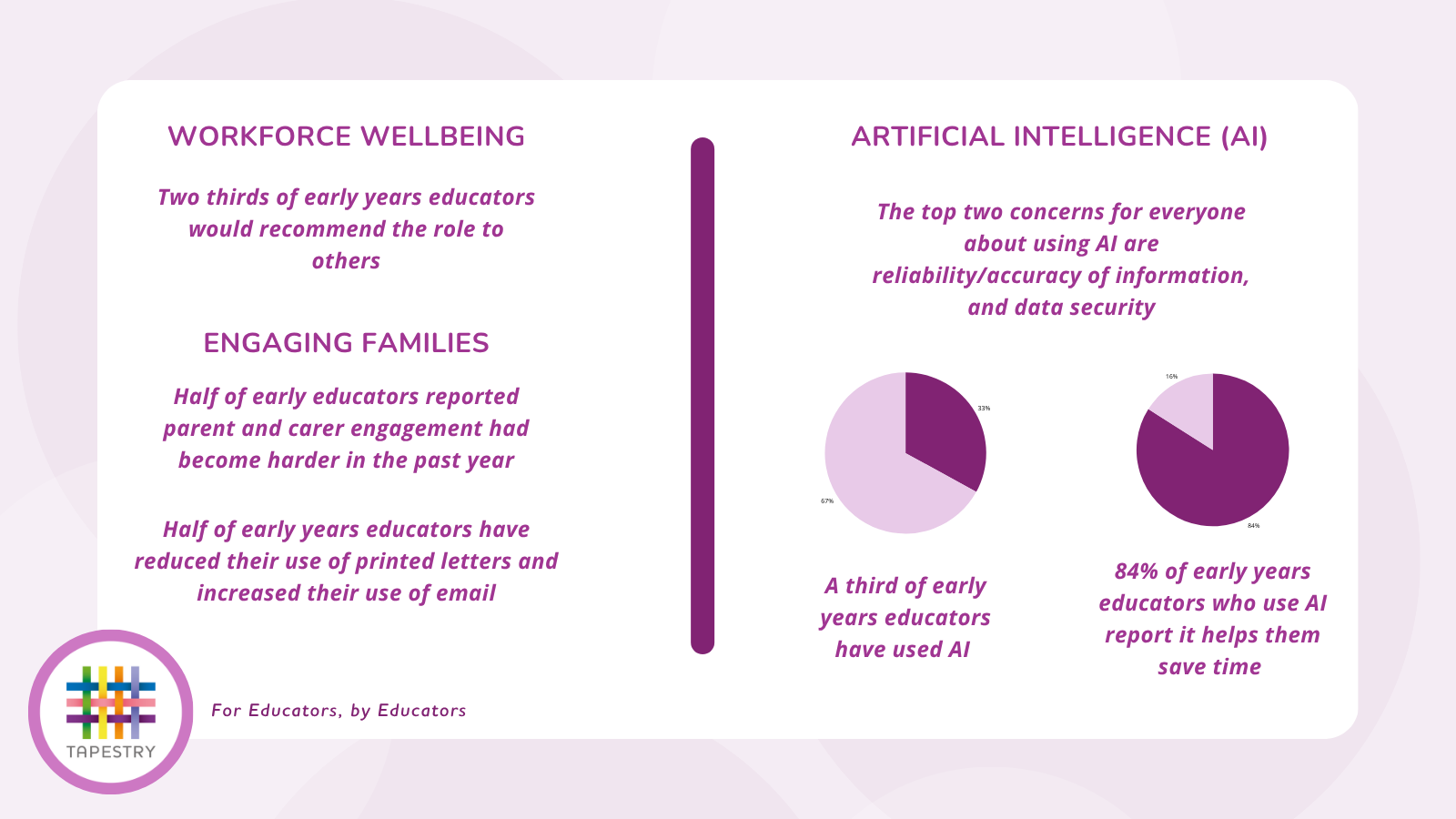
The survey also explored how early years professionals are engaging with artificial intelligence (AI). A third (33%) of respondents said they had already used AI in their role – significantly ahead of the national average, where only 25% of adults report using AI at work or in education[3] (ONS, 2024). Of those using AI, nearly three quarters (72%) said they used it to support administrative tasks, and 80% reported it helped them save time. The majority (84%) also said their use of AI had increased over the past year.
Amongst the two thirds (64%) who had not yet used AI, the most common reasons given were that AI wasn’t relevant to their role (42%), they knew nothing about AI (36%), or didn’t have time to find out about AI (30%).
Looking ahead, half of those that had not used AI (53%) were undecided about using it in the future. This may suggest that access to training and more information is needed. Less than a fifth (17%) said they would use AI in the future whilst a third (30%) said they would not.
However, whether or not the respondents had used AI, their two key concerns were the same – namely the reliability and accuracy of information and whether uploaded data could be accessed by others. The lack of regulation over the use of AI and that it’s not been widely tested in early years were also concerns.
Ben Case, Education Advisor at Tapestry said: “It’s incredibly encouraging to see early years educators embracing AI at such a pace. The fact that it’s enabling them to save time on administrative tasks demonstrates its potential to help reduce workload – a key issue which our survey highlights.
“It’s essential that concerns around reliability and data security are addressed, and early years educators need proper training and support to harness AI effectively. Most importantly, we need to use these tools to enhance and support educators’ significant expertise in child development, rather than seek to replace it.”
Engaging families has become harder
The survey also asked early years educators about engaging parents and carers, and virtually all respondents said they were proactive in trying to engage families. However, half (50%) reported that parent and carer engagement had become harder in the past year.
Where parents and carers experience barriers to engagement with a setting, respondents were most likely (90%) to focus on face to face chats and meetings to support them. A quarter (23%) also reported using online tools like Google Translate and two thirds (63%) involved a child’s key person in helping to build a relationship with their parent or carer.
An area of significant change has been the approaches settings use to communicate with families. Five years after the start of the pandemic, communicating with families has become far more digital. Half of respondents (51%) reported reducing their use of printed letters and a fifth (21%) reported less use of face to face meetings. At the same time, half (51%) reported an increased use of email and a third (35%) reported increased use of online meetings.
Dr Helen Edwards, co-founder of Tapestry and a former nursery owner, added: “Since its inception, and in the years after the pandemic, Tapestry has developed new tools to support educators as they seek to communicate in a digital-first world. We are always surprised at how quickly settings take up these new tools and I think it is driven by a wish to engage with families as effectively as possible.”
https://tapestry.info/tapestry-early-years-education-survey-2025-what-we-learnt/

