- School Attendance Gap Day is a new Awareness Day led by school attendance charity School-Home Support.
- The School Attendance Gap represents ‘lost learning’[1] as a result of absence from school.
- 4th February 2025 is School Attendance Gap Day, which signals the final school day of the year for ’severely absent’ pupils – those who miss 50% of school.[2] Click here to use the campaign’s School Attendance Gap Calculator which we’ve created to help schools talk about lost learning through absence.
- The problem of ‘severe absence’ is getting worse rather than better. In 2025, School Attendance Gap Day is the final school day for 158,000 pupils in England. This is an increase of 149% from before the pandemic (2018/2019).
- School-Home Support is calling for the Government to carry out an up to date assessment of the cost of pupil absence to the economy. The last assessment was conducted by New Philanthropy Capital in 2012.
- By shining a light on the ‘lost learning’ as a result of absence, School Attendance Gap Day aims to promote positive collaboration to build an inclusive education system and encourage a laser-like focus on tackling school absence.
Today, 4th February 2025, is the halfway point in the school year for state-funded schools in England, and so signals the final day of school for the 158,000 pupils who are ‘severely absent’.[3] By the Government’s definition, ‘severely absent’ children are missing at least 50% of school, meaning they are out of school as often as they are in and losing half of their learning.
The number of children missing this much of school is 149% higher than pre-pandemic (2018/2019).[4] This means that collectively we are still failing huge numbers of children, and the problem of school absence is getting worse not better.
There is still a school attendance crisis.
Almost 1 in 5 children are ‘persistently absent’ – missing enough school to damage their life chances. Absence continues to disproportionately impact vulnerable children and those from disadvantaged backgrounds. According to data collected by the Centre for Social Justice (CSJ), Children eligible for Free School Meals (FSM) were 3.56 times more likely to be ‘severely absent’ than children who were not eligible. Data from School-Home Support’s practitioners indicates that issues relating to home, money, and employment are the most pressing problems for families receiving support for their children’s attendance.
We need a laser-like focus on tackling school absence.
By marking this day each year we can measure our collective progress in tackling absenteeism. The school attendance crisis is complex and systemic. It has always been ‘a symptom rather than a cause, a manifestation of complex issues in the education system and beyond.’[5] To tackle it we need a laser-like focus and the power of collective endeavour. School Attendance Gap Day will fall on approximately the same day each year – half way through the academic year – but the number of children who have their final day on this date will change.
Mind the Gap: The long term consequences of low school attendance.
The school attendance gap represents the learning lost by children who miss school. It relates to learning of all kinds – including academic, social and practical. The consequences of lost learning are significant, contributing to cycles of deprivation, missed opportunities and lost potential.
- Lower Attainment. There is a proven correlation between school absence and school attainment. Data from the Children’s Commissioner report ‘Missing school, missing grades’ reveals that 78% of pupils who were rarely absent in both years passed at least 5 GCSEs, including English and maths, in 2022. By comparison, just 5% of pupils who were ‘severely absent’ met the same standards.
- Reduced Social Mobility. The Social Mobility Commission views NEET (not in education, employment or training) as a key indicator for social mobility. Research has found that persistently absent children and young people (missing 10% or more of education) are 3.9 times more likely to be NEET and 6.3 times more likely to be persistently NEET.
- Risk of School Exclusion. The Who is Losing Learning Coalition has found that children who are ‘severely absent’ from school are also five times more likely to be permanently excluded than the national rate, suggesting that ‘severe absence’ may correlate with behavioural problems that schools do not have the capacity to address.
- Exposure to Harmful Influences. School provides a strong protective effect from harmful influences. Analysis from the CSJ in 2023 indicated that the rising rates of school absences could create an extra 9,000 extra young offenders by 2027 if left unresolved.
A cost to the economy.
An assessment of the cost of pupil absence to the UK economy was last undertaken by New Philanthropy Capital in its 2012 report. It found that the failure to address truancy from school is £800m per year or £8.8bn across 11 years of education. This covered the cost to the education system, health service and social services and the cost of lower earnings and of higher crime. There is a clear opportunity for the Government to provide an up to date, formal analysis of the cost of absence to the economy.
Why do we need this campaign?
The purpose of School Attendance Gap Day is to raise public awareness about the worryingly low levels of school attendance and promote positive collaboration to build an inclusive education system so we can tackle absence. The system is currently failing far too many children who urgently need support to be in school.
By showing support for School Attendance Gap Day, we want to inspire collective action to:
- Go further and faster to close the school attendance gap
- Support families whose children are losing learning by missing school;
- See an inclusive education system which recognises that each child is different;
- See absence tackled through more support and fewer fines.
How to get involved:
Help us to raise awareness of the consequences of school absence, and encourage positive collaboration to move further and faster close the school attendance gap. Join in the conversation and show your support for the campaign by sharing our campaign board and social media post, tagging us on Linkedin, Facebook and Instagram and using the hashtag: #SchoolAttendanceGapDay.
Children take a stand for school attendance.
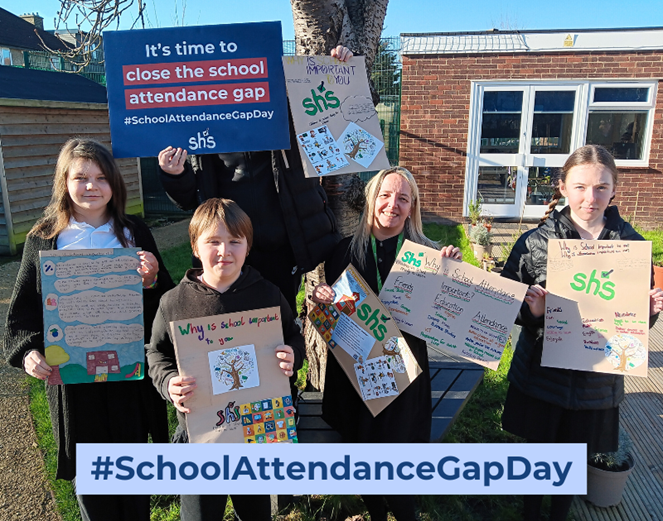
Pupils in one of School-Home Support’s partner schools have taken part in the School Attendance Gap Day campaign, using their creativity to highlight why being in school matters. Through a series of powerful posters which they made in art class, they shared their thoughts on the importance of attendance – not just for academic success but also for personal growth, friendships, and future opportunities.
With colourful designs and bold messages, the posters reflected the pupils’ own experiences. One pupil wrote, “Coming to school helps you socialise and learn how to behave correctly.” Another talked about the long-term impact of attendance, saying, “The lower your attendance is, the less likely you are to be successful in life.”
For many, school is more than just a place to learn – it’s where they build friendships and develop essential life skills. When asked why attendance is important, pupils responded:
- “Because you need education for the future.”
- “To study, to have fun with friends.”
- “You have less chance of achieving GCSEs if you don’t come to school.”
The campaign gave pupils the opportunity to express their views in their own words, reinforcing a crucial message: attending school isn’t just about passing exams – it’s about building a foundation for life.
By taking part in School Attendance Gap Day, these pupils have shown that, given the right support, they can thrive. Their voices serve as a reminder that every child deserves a chance to learn, grow, and succeed.
Baroness Anne Longfield, Executive Chair of the Centre for Young Lives said:
“The number of children absent from school for half or more of the academic year, and who have their effective final school day today, is shocking. The reasons why children miss school are often complex and overlapping, and can have negative implications for their life chances. We need to build an education system that is inclusive, where every child feels a strong sense of belonging and children are supported so they don’t miss out on learning.”
Jaine Stannard, School-Home Support CEO said:
“I am delighted Bridget Philipson used her speech today to talk about the importance of strong partnerships between schools, services, parents and carers and the voluntary sector when it comes to tackling absence. The aim of School Attendance Gap Day is to highlight the importance of collective action to improve school attendance. The school attendance crisis isn’t going away, despite huge efforts by schools. We need to go further and faster to help families get the support they need so their children don’t miss out. As a charity, we know our holistic, whole family approach to tackling absence works with those we reach, but there are so many more families who need support with attendance. We are working with schools to share best techniques in supporting families with absence but we need radical collaboration across society to close the School Attendance Gap.”
[1] The concept of ‘Lost Learning’ was coined in a report by IPPR and The Difference.
[2] ‘Severe absence’ is defined by the Government as when a child misses 50% of school or more.
[3] According to the latest official Government statistics: ‘Pupil absence in schools’ Autumn and spring term 2023/24.
[4] Comparing official Government statistics from 2018/19 and 2022/23.
[5] Burtonshaw and Dorrell, ‘Listening to, and learning from, parents in the attendance crisis.’